Hail
Split Ribs And Punctured Membrane
Hail breaks steel panels at the ribs and punches small holes in membrane that only leak once water ponds over them.
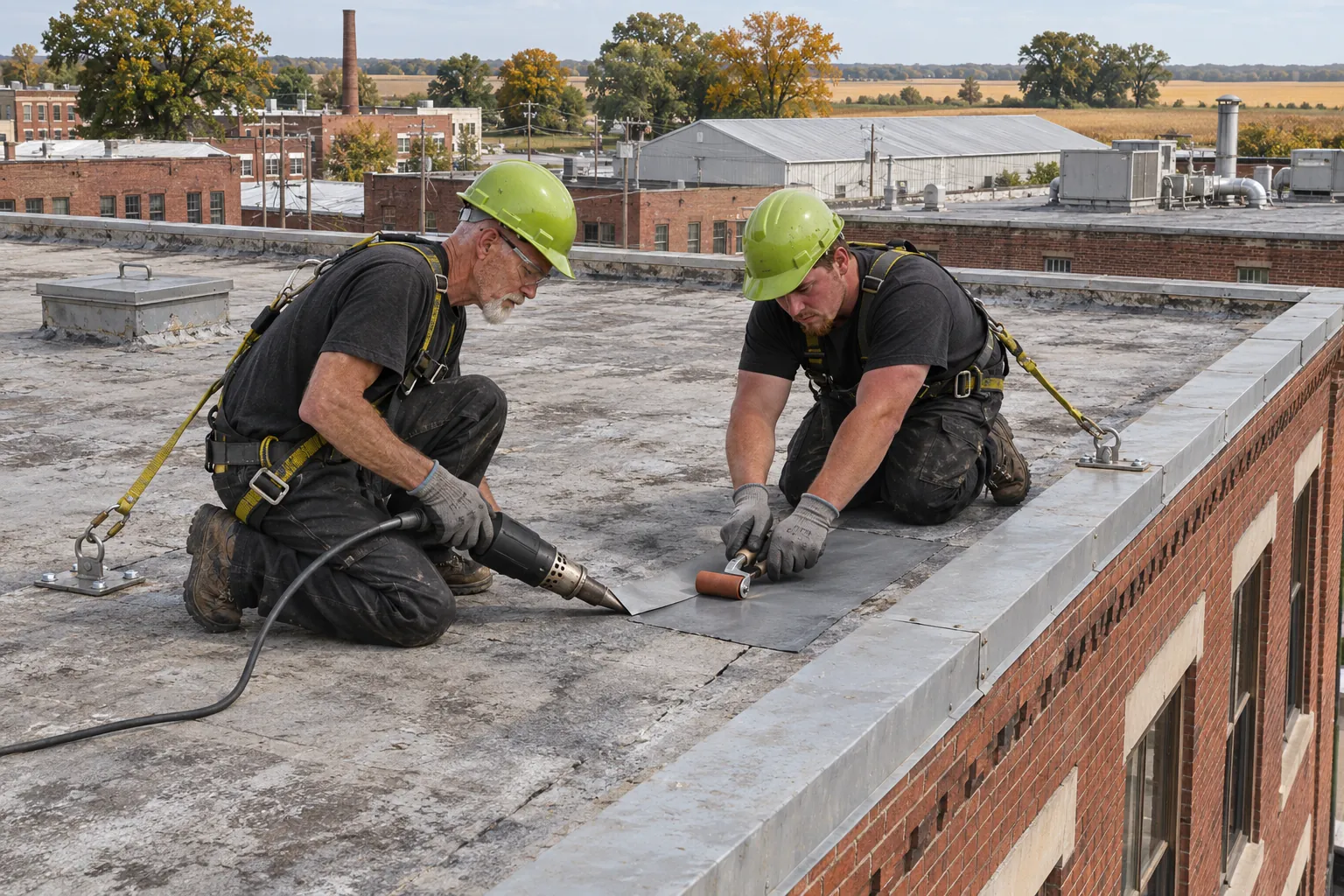
As a New Castle commercial roof repair contractor, we walk plant, warehouse, and shop roofs after storms and repair the punctures, lifted edges, and clogged drains we find.
New Castle commercial roof repair calls spike after spring storms, when hail, wind, and packed drains all hit the same week.
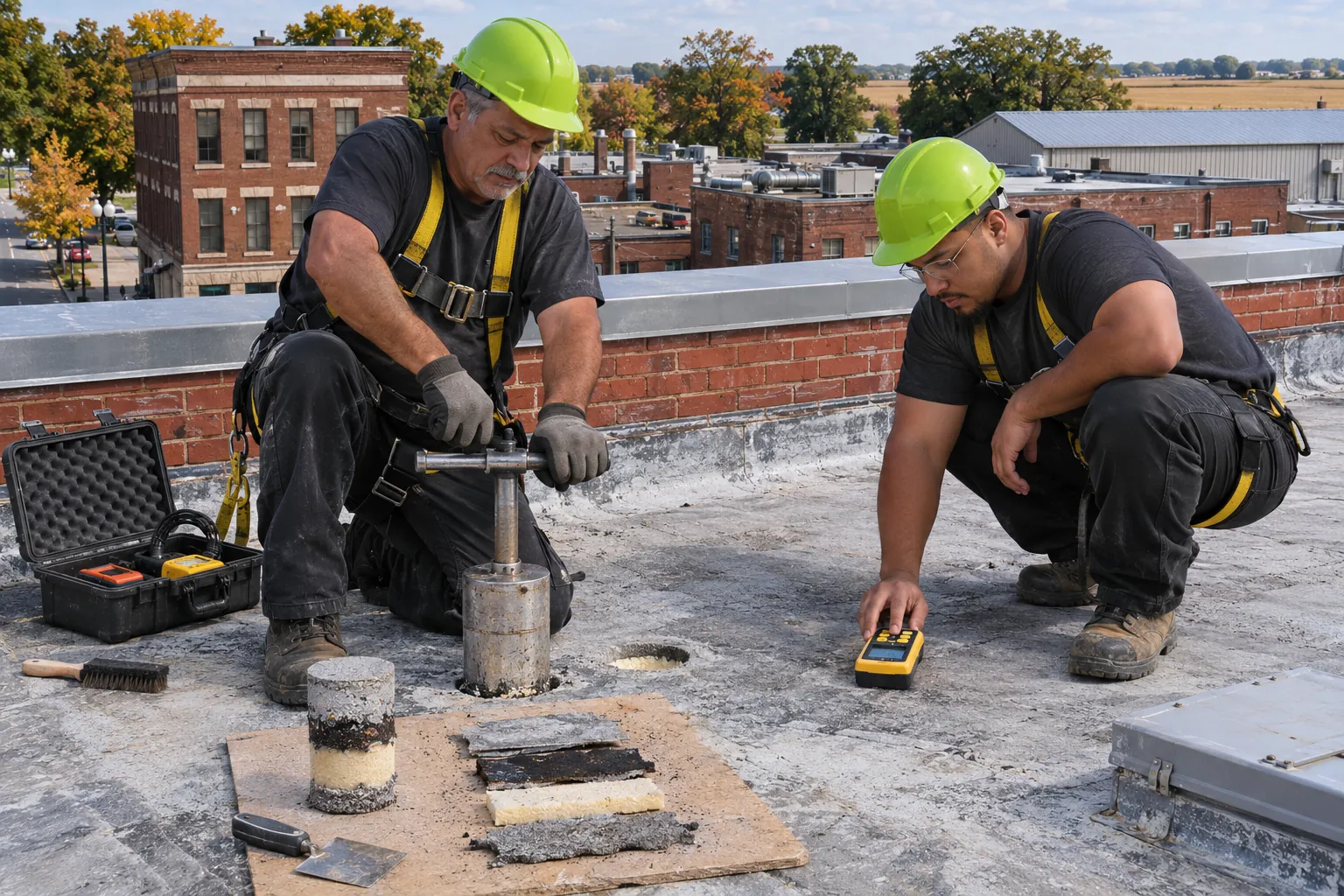
Big flat and metal roofs on New Castle plants and warehouses take hail across the whole field, so one ceiling stain rarely tells the full story. We walk every section, mark each split panel, puncture, and lifted edge, and clear drains packed with leaves and debris.
Temporary seals go on anything open before the next rain, and the permanent repairs follow on a dry day.
What a storm walk turns up most often here.
Hail breaks steel panels at the ribs and punches small holes in membrane that only leak once water ponds over them.
Gusts get under loose edge metal and lift the membrane behind it, opening a long gap along the roof edge.
Leaves and branches choke strainers, water backs up, and seams near the drain start taking on water.
Plastic skylight domes and vent caps crack under hail and let rain straight through to the floor below.
Falling limbs and hail crush gutter edges and downspout heads, so water spills over the eave and down the wall instead of the pipe.
Storm repairs protect the floor, the stock, and the insurance claim.
Dated photos of each split panel and puncture give an adjuster what they ask for.
Temporary seals on storm openings keep the next rain out of the insulation while the permanent fix is scheduled.
Clearing packed strainers right after a storm keeps water from sitting on seams that already took a beating.
The fix depends on which roof the storm hit and how.
Punctured or split panels come out and new ones in the same profile go in, lapped and screwed into the purlin.
Hail holes in membrane get cleaned and patched with matching material, welded on TPO and taped on EPDM.
Loose edge metal gets refastened and the membrane behind it reattached so wind cannot get under it again.
Packed strainers get cleared and loose clamping rings tightened before the next storm arrives.
Call with the address. Open spots get a temporary seal before more rain.
Call UsSend the address and storm date. We walk it and photograph what we find.
Get A Free EstimateFive decisions between the storm and the finished repair.
Every section gets walked, not just the area over the stain, because hail spreads damage across the whole roof. Splits, punctures, and lifted edges get marked and photographed.
Openings that let water straight in get a temporary seal right away, so the next rain does not reach the insulation while repairs are planned.
Cosmetic dents get noted and left alone. Split ribs, holes, cracked domes, and lifted membrane go on the repair list with a photo each.
Panels get swapped, punctures patched in matching membrane, edge metal refastened, and strainers cleared and reset.
The photo set with dates, a list of each repair, and the materials used, ready for the owner or an adjuster.
Drains get left clear, edge metal tight, and skylight domes checked, and the owner gets a short list of spots to look at after the next big storm passes through.
We take commercial roof repair work in New Castle, Muncie, and four other towns. Not on the list? Call us or send us a message.
Storms, cost, and getting a roofer out.
Flat, metal, and industrial roofs on plants, warehouses, and shops. The walk starts where water shows up inside and follows it to the opening on the roof, and any other weak spots seen along the way get pointed out to the owner.
Price follows the damage: how many spots, how big, whether insulation is wet, and how hard the roof is to reach. A single puncture costs far less than a row of split panels. The free estimate measures it and puts the price in writing.
We do. New Castle sits inside our regular area from Muncie, so a storm call gets a roofer on the roof to seal open spots and photograph the damage before the permanent repairs.
Yes. Dated photos of each split panel, puncture, and lifted edge, plus a written list of repairs, are what adjusters usually ask owners to provide.
It can. Small holes in membrane and cracks at panel ribs often stay dry until water ponds over them or freezes in them, which is why a full walk after a hail storm beats waiting for a stain.
Bent gutter edges and crushed downspout heads on commercial buildings get straightened or replaced, and the eave flashing behind them gets checked so water goes down the pipe again.
As soon as the roof is safe to walk, ideally before the next rain. Small holes and lifted edges stay dry at first, then leak once water sits on them.
Cracked domes get replaced, since patches on plastic rarely hold through another hail season. The curb flashing under the dome gets checked at the same time.
Tell us when the storm hit and where water shows up. We walk the whole roof and fix what it broke.